Tuesday, 23 February 2016

School Pairs Tournament

A couple of weeks ago we had our first Pairs Tournament to determine the top pair in the school (of those that were present). Because we only meet during lunchtime I stretched it over two days and was flexible with who played which boards. I used deals which had already been played at the Buchanan Club and compared each result with the average for pairs sitting in that direction, which meant it didn't matter if only one pair in my tournament played a board.

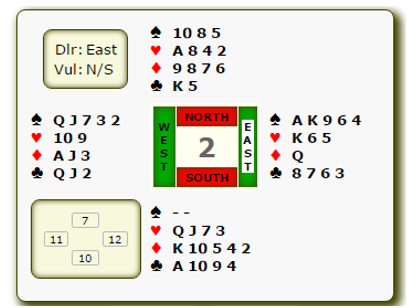
Of course it was better when several pairs played the same board, and I was pleased to see the kids informally comparing outcomes on the same board. For example:

On both tables North-South went overboard. First Amelie played 2NT-3, then Jack played 3NT-3. Jack felt he had done better than the other declarer, by making more tricks, but I had to explain that he got the same score. When Anna and I played this hand at the Buchanan we sat East-West and got a good score for defeating 3♦x by two tricks.

On the first table Sophia sitting East bid and made an excellent 4♠. When Anna and I played it we sat East-West and also made 4♠. It's actually unbeatable as long as the defence don't find an unlikely Club ruff. How Sophia and Amelie got to 4♠ I don't know, but I imagine there was some competitive bidding. It was certainly competitive at the other table, as South got to 5♥, doubled and redoubled. This went four off, for a massive score of 2200 to Amy and Ewan in defence.

However, I'm pleased to say that enough hands were played that this giant penalty didn't determine the overall score, and it was the pair that made four game contracts (two of them doubled) that came out on top:

After half-term I'll have another go at organising a more formal pairs tournament when everyone is able to play. I think the pupils enjoy the extra pressure, and it forces them to speed up too.

Best hand ever

At my school bridge club last week somebody dealt themselves this hand. My first thought was that she'd rigged the deck, but I don't think that's possible because I shuffled and gave her the pack of cards to deal, which she did while I stood beside her writing something on the board.

What I was writing on the board was point ranges for opening bids. I didn't cover opening 36 point hands. In the end she settled for a 6NT opening bid and played there. This was the full deal and auction:

♠ A K Q
♥ A K Q
♦ A K Q
♣ A K Q 2
♠ 6 4
♥ J 5 4
♦ 7 5 3 2
♣ T 5 4
WNES
6NT---

I was the dummy and did not have the vital ♣J (and my ♥J is useless) and Clubs only produced three tricks, so declarer claimed her twelve top tricks for 6NT=. I like it when they claim early, as it shows they are aware of what is required for the contract and know how many winners they have.

I hope that the pupils will not be expecting another hand like this, as it could take many lifetimes. It's very rare to have above 20 points, as the table below shows (adapted from RP Bridge).

PointsProbability
191.0%
200.7%
210.4%
220.2%
230.1% (1 in 1000)
...
290.00066% (1 in 150,000)
...
350.00000009827% (1 in 1 billion)
360.00000000945% (1 in 10 billion)
370.00000000063% (1 in 1600 million)

Since the probabilities fall off so quickly you're in fact more likely to get a hand of 21 points than any hand with more than 21 points. Or to put it another way, more than half of 21+ point hands have exactly 21 points.

And what about that massive 36 point hand? The probability of getting one of those is a staggering 1 in 10 billion. That's more than the number of people on Earth. So the probability of getting a 36 point hand is less than the likelihood of lining up everybody in the World randomly and you happening to be at the front. Or, alternatively, if you deal yourself one hand a second night and day it would take on average about 300 years before you saw one this good. If you deal yourself a more modest thirty hands a day it will take about a million years.

My best ever hand was a balanced 29 count. The bidding went like this:

2♣12♦2
5NT37NT4

1: 23+
2: Weak or waiting
3: Showing 29-30 (on the logic that 2NT rebid is 23-24, 3NT rebid 25-26, 4NT rebid 27-28, 5NT rebid 29-30)
4: Actually had about 10 points and six good clubs

7NT made with about 18 top tricks. What's your best ever hand?

Saturday, 19 December 2015

2015 Cheating Scandals

2015 will be remembered as the year of bridge scandals, as several World Class pairs have been accused of systematically cheating.

The background

Last year it emerged that Dr. Michael Elinescu and Dr. Entscho Wladow had been illegally communicating during the 2013 World Senior Championships. They are now known as the German Coughing Doctors. Their basic code was that one, two, three or four coughs meant Clubs, Diamonds, Hearts or Spades respectively. This was used both in the auction, to tell partner about a shortage in the indicated suit, and just before the opening lead, to suggests a suit to partner. They were an eccentric pair with other mannerisms and hand movements (a theme we will see repeating) and there may have been more to their code. They have been found guilty by both the World Bridge Federation and German Bridge Federation, but maintain their innocence (another recurring theme).

This year things began relatively quietly, when at the end of the 2015 World Championships in Chennai a cryptic note in the Daily Bulletin stated that the well-respected American Senior Mike Passell “was found guilty of violating CDR 3.1 (Laws of Duplicate Bridge), 3.7 (Actions unbecoming a Member participating in an ACBL event), 3.20 (Ethical Violations) and E13 (Prearrange a deal or part thereof).” It eventually emerged that Mike had been accused of deliberately creating a ‘fouled board’, by messing up the cards on a deal he’d already played so it couldn’t be played at the other table, and was therefore unscored. This occurred on a hand where Mike had already received a bad result, so it didn't look good. In his defence Mike explained that he had noticed a card face up on the floor and merely added it to the wrong pocket. He admitted an error of judgement in not calling the director, but denied deliberate wrongdoing.

Fisher-Schwartz

This was soon overshadowed by much bigger news, when after his narrow quarterfinal loss in the prestigious Spingold tournament Norwegian Boye Brogeland publicly accused Israeli pair Lotan Fisher and Ron Schwartz of cheating (without saying how), and promised there were more revelations to come. Analysis of video evidence from Per Ola Cullin of Sweden found a link between where a defender placed the tray containing after the auction and the suit he wanted partner to lead.

In this video still Fisher (leftmost) is on opening lead and Schwartz (opposite) is about to place the yellow board down. His board placement matched the suit that he wanted partner to lead, as indicated by the suit symbols. Tellingly, Schwartz’s irregular placement of the board only occurred when his partner was on lead; the rest of the time he placed the board in the middle of the table like everyone else.

The code is nicely explained in a YouTube video by Michael Clark, and there is an analysis by Kit Woolsey on the BridgeWinners website.

Boye set up a website called BridgeCheaters.com outlining the accusations and occasions where F-S achieved good results by suspected foul play, and suggesting there may have also been a coughing code. Naturally F-S denied the allegations, and have hired a lawyer and set up their own Facebook page in defence.

Fantoni-Nunes

Then came the next bombshell, as BridgeWinners.com announced that they had “received overwhelming evidence alleging improper communication between the world’s #1 and #2 ranked bridge players, Fulvio Fantoni and Claudio Nunes, during the 2014 European Championships.”

It took some time before the actual cheating mechanism was unearthed by Maaijke Mevius from the Netherlands. The opening lead is placed vertically when the suit contains an Ace, King or Queen (or is a singleton) else is placed horizontally. This extra nugget of information allowed the partner of the opening leader to defend with much greater accuracy, particularly as ‘Fantunes’ as they are known, play an unusual system of Slawinski leads where the opening lead is often ambiguous.

A team of volunteers (including some Bridge Internationals) reviewed hours of footage and found the orientation of the opening lead followed this system on 82 out of 85 deals. Notably, both F-S and Fantunes were under suspicion before it was known how they were cheating. This was because of their uncanny good fortune and unjustifiable winning decisions had stood out to other experts.

Their is another Michael Clark YouTube video and analysis by Kit Woolsey.

In this video Fantoni (leftmost) makes the opening lead horizontally. His partner now knows he has no high honour in that suit, and no singleton. There may also have been more to their code. The pair were investigated in 2014 for the infamous Blackout Defence, where Nunes made a very illogical but successful action then claimed it was because he had a blackout.

Smirnov-Piekarek

After the Fantunes revelation there were rumours of a ‘third pair’, confirmed German Internationals Alex Smirnov and partner Josef Piekarek announced on the BridgeWinners website that they were “aware of the ‘whispers’ circulating about our ethical conduct, and we are sorry to say there is some truth to them. We regret that in the past as a partnership we committed some ethical violations” (read more here).

Some applauded their honesty, some said they only came forward as they were about to be rumbled (“sounds like an advance sacrifice” said Tom Hanlon of Ireland). With the World Championships about to take place in Chennai in India there were now pairs from Israel, Monaco and Germany under suspicion. All three teams withdrew from the tournament, a blow for their supporters and honest team members.

Balicki-Zmudzinski

The Polish team did not withdraw, despite rumours about Cezary Balicki and Adam Zmudzinski (known as B-Z). It was found that they were communicating illegally by how they spaced out their bidding cards. A card placed close to the previous bid indicates a minimum hand for the previous bidding, a well spaced out bid means a maximum for the previous bidding.

The analysis of this was thoroughly done, with one set of analysts looking at the spacing of the bids, and a separate set independently looking at whether the bids were maximum or minimum. A very strong correlation was found. Although the video resolution is poor the spacing of the bids can be seen nicely in the videos in Kit Woolsey’s analysis on BridgeWinners.com.

B-Z are known as an eccentric pair, not least as sometimes Zmudzinski touches the dummy while in defence. Above is a still from Australian Ishmael Del Monte’s article on Bridge Winners entitled ‘A Helping Hand’. Balicki fans out dummy’s Spades with all five fingers. He had five Spades himself (shown above). A correlation was found between the number of fingers he touches a suit with and his own length in that suit (see here).

Just before the World Championship the WBF withdrew the credentials of that pair, but allowed Poland to compete with other players. Controversially they won, and were crowned World Champions.

The future

With the notable exception of Smirnov-Piekarek all the pairs claim their innocence, so in that sense the cases are not settled. National and International bodies are deciding how to act, as are tournament organisers whose previous winners are now tainted. There are also of course rumours of a ‘fifth pair’, and investigations continue.

Collectively the accused pairs have exploited many methods to communicate, which work even with screens, using audible coughs and visible finger, board, bid and card placement. There is even speculation about other possible ways of exchanging information, such as the angle of the scoring pen.

In response to these weaknesses Fred Gitelman of Bridge Base has designed a hybrid computerised version of the game where players meet around a table but input their bids and plays on tablet computers. This would cut out some methods of communication, and make recording suspicious activity much easier. However for some experts, notably Sabine Auken, this lacks the visceral excitement of playing with cards; picking them up and seeing what you’ve been dealt.

Although for most club players the cheating scandal just leaves a bad taste, one positive thing is that the elite game is now cleaner than ever, which is good news for the other top players who have been so active in the investigations.

Finally, here is probably the best summary in the popular press from Newsweek.


If there are any errors or inaccuracies in my article please let me know and I can correct them - Thanks, Danny.

Resulting

The school bridge club that I look after has come on leaps and bounds, as we've been meeting twice a week this term. The focus has been on play and defence and I've left the bidding to be natural, only emphasising the value of the game bonus.

We've had a couple of three-board Team's Matches, which is the first time I've been able to get anyone interested in scoring. More importantly, I was able to introduce the notion of resulting, which is when you decide what people should have done based on unknowable factors. For example, saying "I should have bid 4♥" just because 4♥ happens to make on a lucky layout.

In our match I was impressed that on all three boards reasonable contracts were reached on both tables, despite the lack of bidding sophistication. This was the one that decided the match:

Board 3
Dealer: S

North
♠ 7
♥ J974
♦ T
♣ AK96432
West
♠ 4
♥ Q32
♦ K9862
♣ QJT5
8
811
13
East
♠ KQT965
♥ T85
♦ AQ74
♣
South
♠ AJ832
♥ AK6
♦ J53
♣ 87

On one table South opened 1♠, West made a 2♦ overcall, North bid Clubs and after a good competitive auction ended up in 5♣. When this came round to West she doubled. The kids love doubling, and tend to do it far too often, but I think this time she had her bid.

In 5♣x declarer ended up losing two trump tricks, along with a Diamond and a Heart. It is possible to avoid losing two Clubs with an early finesse, and you might avoid a Heart loser with some fancy footwork, but that's beyond us at the moment and the result was 5♣x-2. On the other table North played a sedate 3♣= for a big gain on the hand.

Afterwards North was roundly blamed for overbidding in getting to 5♣. However, if the trumps had split 2-2 he would have made it. So that was my lesson for the day - just because a contract fails it doesn't mean it's a bad contract.

Sunday, 11 October 2015

One hand from the Bermuda Bowl

The Bermuda Bowl is the bridge equivalent of a World Championship, and just took place in India. Put yourself in one defender's shoes for this deal.The opponents have just reached 3NT, after bidding some minors then checking for stops. You and your partner have been quiet throughout. What do you lead from this?

♠ T843 ♥ KQJ43 ♦ J8 ♣Q5

I expect you chose the obvious ♥K. When the hand was played live in the quarterfinal match between England and USA1 one of the commentators suggested instead leading a deceptive ♥J. But at the table the English defender, Andrew Robson, went one better and lead the ♥4! This was the full deal:

The American declarer sitting East assumed from the lead that Hearts were splitting 4-3, and was worried that if he ducked the Heart he'd get a Spade switch. So he immediately won the ♥A, reasoning this way he would lose only three Hearts and a Club. However, once the defence got in Robson surprised everyone at the table by cashing four Heart tricks to set the contract. On the other table game made easily ("Difficult to see how 3NT can go down" said the commentator).

I like this deal as it shows the subtelty the expert game. Any intermediate player would have lead the ♥K, but an expert leads like a beginner and plays fourth highest.

Glasgow League Division Two - Buchanan vs Team Rowan

Team Rowan scored a fantastic 15-1 win in the first match of the season. Could they maintain that form with Anna and I in the team?

Things started badly. Our opponents seemed to be bidding and playing very slowly, and in response we got a bit tired and the bidding suffered. As an example of how it all seemed to go wrong after Anna had passed I opened a light 1♥ and she responded 2♣, natural and showing 10+. I had ♣AKx so passed. On another day Anna would have five or six Clubs and 2♣ would have been a good contract, but today it was a 4-3 fit and went two off.

At one point the opponents had a mix-up and ended in a 6-1 Spade fit. If we'd have been sharper we could have beaten it, but instead let declarer make it. Anna made a couple of good 3NTs, but then we went off doubled in a bad sacrifice, twice. This was the low point:

No one vul
N deal
♠ 9 x x
♥ x x
♦ J x x
♣ A Q J T x
♠ K J x x x
♥ K x
♦ Q x
♣ x x x x
8
913
10
♠ T x
♥ Q J x
♦ A K x x x
♣ K x x
♠ A Q x
♥ A T 9 x x x
♦ x x x
♣ x
AnnaDanny
WNES
-1♦3♥
3♠4♥x-
--

East opened 1♦. With Anna having already passed I felt like I was right for a weak 2♥ overcall, but decided to spice things up a bit and bid 3♥. No particular reason, but I was a bit bored perhaps. The pre-empt worked as West was forced to make a stretch to bid 3♠. However, Anna wasn't in on this and thought I had a genuine 3♥ bid with something like ♥KQJxxxx and so raised me to 4♥. East doubled and I had to take the medicine.

The defence took three Diamond tricks then East switched to the ♠T. I covered and West won the ♠Q. He couldn't continue Spades so lead a Club. I thought about finessing but thankfully didn't, and was able to hold my losses to 4♥x-4, which still cost 800. On a part score hand this is expensive, especially on aggregate scoring.

After all the other tables finished we were still playing. At one point someone actually turned out the lights, then realised we were still playing. It was just our table left and the two team captains waiting for a result. The very final board epitomised the disaster. After I had opened 1♥ partner was silent and the opponents reached 3NT. I had:

♠x ♥ JTxxx ♦ AQxx ♣Qxx

Obviously I lead a Heart, and then found partner's only points were five Diamonds to the King. In the end we lost the match 12-4. As the team captain said, it could have been worse!

Sunday, 4 October 2015

Saturday Night at the Club

Saturday night at the Buchanan is a new event at a convenient time, so last night Anna and I made our return to the club. It's been six months since we've played any Matchpoints.

While the standard did not quite rival the Bermuda Bowl (happening right now in Chennai) there were a few highlights. Three times I doubled aggressively when Anna and I had a misfit, and every time we took them down two or more. Once we made 12 tricks after an opponent revoked, and afterwards I could hear someone at another table trying to figure out how on Earth someone had made 4♥+2.

The hand I remember best though is of course one where I didn't get things right.

AnnaDanny
WNES
1NT-2♥*3♦
--4♥-
x-

Although we play a weak NT, Anna opened her 15 point hand 1NT. Neither of us noticed this until the next day. My plan was to transfer to Spades then bid Hearts, which for us shows at least 5-4 and is game forcing. But after I transferred into Spades South weighed in with 3♦. Anna passed and when it came back to me I wasn't sure if 3♥ was still forcing (I think it is) so bid a potentially ambiguous 4♥. That might have looked like a splinter, but Anna correctly took it as natural and was delighted to pass with her excellent Heart suit.

South passed this too (I would have bid 5♣), and lead the ♦A. "You've hit the jackpot there" said a defender as dummy came down.

I could see loads of Heart winners, loads of Spade winners and just one Club to lose. An easy 12 tricks. I ruffed the Diamond lead and started drawing trumps. After two rounds of trumps though I suddenly realised I had a problem. As trumps had split 3-1 to draw them all was about to take my last trump in hand, after which I would be wide open in Diamonds after losing the Club Ace. It's good I realised this, but a shame I realised it so late. I therefore started on Clubs before drawing the last trump, thinking this was fairly safe. The defence was accurate though and South took her ♣A and gave her partner a ruff. My easy 12 tricks had turned into 4♥+1.

Of course what I should have done right at the start is ruffed a second Diamond in the South hand then drawn trumps, which gets me to 12 tricks with 5 Hearts, 5 Spades and 2 Diamonds. I can even play for all 13 tricks by ruffing all three Diamonds. Every other table made +2, except for those that got an immediate Club lead.

The next time I was sure I had 12 tricks I played much more carefully:

AnnaDanny
WNES
-1♠2♥
2♠-4♥*-
4♠---

I have the 20 point East hand with a void. I decided to only open 1♠, then when Anna showed support I splintered with 4♥. Anna passed this quickly, as she has already stretched to bid 2♠. I got a nice Diamond lead, and so was able to get two tricks out of the Diamond suit and this really was an easy 12 tricks. Every other table was also in 4♠, making 11 or 12 tricks depending on the lead.

Overall we finished in 1st place, and David & Heather were 2nd. Bring on the next league match on Tuesday!