Showing posts with label Beginners. Show all posts

Friday, 13 June 2025

Scottish Schools Minibridge 2025

I took ten pupils on the train to Edinburgh, to the New Melville Bridge Club, joining pupils from Stockbridge, Broughton High and George Heriots. Altogether there were eight tables.

I was impressed by the composure of all the players (age approx 10-12), who were attentive and helped the event run beautifully on time. 

The youngsters I sat with had learned to draw trumps and they counted them accurately. The next stage (for everyone) is to try and keep track of winners. This means master cards (after the Ace and King have gone the Queen is a winner) and length winners (counting to 13).

I saw some good play, but in the pressure of a match situation it's quite common for new players to cash their eight winners and finish in 3NT-1, because they haven't made a plan for the ninth trick, or even counted that they only have eight tricks.

I think this shows how hard bridge is - it takes a lot of practice before good play, or even standard play, becomes automatic. Enough complaining, here are the results:


Well done the top North-South (Raphael & Charlie from Stockbridge) and top East-West (Max & Zach from Broughton High). These pairs bid and made lots of games, so were worthy winners. These results will later be combined with the heat in Aberdeen for our overall winners.

The top HSOG pair were Hanlin and Noah, who finished 3rd East-West. Well done boys!


Saturday, 10 February 2024

Glasgow vs Zimbabwe

When a school from Zimbabwe contacted the SBU looking for a friendly bridge match they were put in touch with me, as the teacher of a school club in Glasgow. I arranged the match on RealBridge, which turned out to be between two schools in Harare, Dominican Convent and St John’s, and The High School of Glasgow representing Scotland.

After the inevitable connection difficulties and general confusion (“you can leave the ID number blank!”) it looked like we had maybe seven or eight tables. Given that it’s always better to have substitutes than empty spaces, I reduced it to six tables and combined some teams. After four rounds of two boards each, these were the top three:

Glasgow #2 Niamh R & Rachel Y, Kevin R & Michael K 61 VPs
Dominican #1 Tinashe Z & Daniel R, Nomalangu N & Vongai T 52 VPs
St John’s #2 Susannah P & Gabriella B, Taona Z & Ngavatendwe N 48 VPs

It’s no coincidence that all of the top teams had at least one pair that bid and made games (and Glasgow had two). Bidding and making games is the key to success in Teams matches.

Overall it was quite a chaotic hour of bridge, but I enjoyed seeing all the youngsters play and hope to do it again soon. Most of them had never used RealBridge before, but that didn’t seem to matter much and they picked it up very quickly. There were a few skipped boards for slow play, one unusual 4♦x-8, but also some good play and plenty of potential for the future.

Below I’ve chosen three hands to write about, where there are some good teaching points to pass on to the mostly beginners who were playing. As it’s the most important part of the game, in each case I’m going to focus on declarer play.

In this deal two East-West pairs got to 3NT. Will it succeed?

I encourage my pupils to count top tricks in NT contracts. A quick count reveals that this is one of those happy deals where we’ve been dealt enough top tricks to make the contract (1 Spade + 0 Hearts + 6 Diamonds +2 Clubs = 9). In practice we might get an extra Heart too, but certainly there are nine tricks there for the taking, and indeed both declarers in 3NT made the game easily.

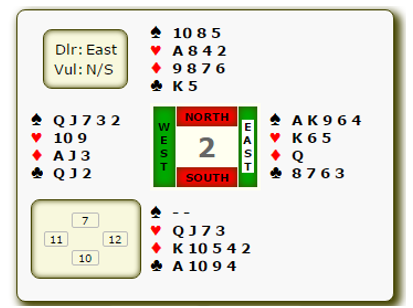
Here 4♥ from North-South was a popular contract, but it didn’t succeed as often as it should have.

For the 3NT contract above we counted sure winners, for this high-level suit contract we instead count expected losers in each suit.

In Diamonds there are two certain losers (but only two, as we can ruff the third and subsequent rounds).

In all of Spades, Hearts, and Clubs we count ½ a loser – meaning that sometimes we will lose 0 tricks and sometimes 1 trick, depending on if a finesse in that suit succeeds. So depending on our luck with finesses we will lose 2, 3 or 4 tricks

The correct way to play the hand is therefore to draw trumps with a finesse, take the Spade finesse, then decide how to play Clubs.

In practice most declarer’s instead failed because they didn’t draw trumps, and West got a ruff with the Ten of Hearts - the message being to draw trumps straight away unless you have good reason not to.

This last deal shows a useful technique, where we don't draw trumps straight away.

Suppose we are sitting South as declarer in 2♠. We have four trumps in each hand, plus a short suit in both our hand and dummy. The fact that we have these shortages means our plan should be to cross-ruff the hand. That means not drawing trumps at all, but instead going from side-to-side ruffing everything we can.

On this deal cross-ruffing makes a lot of tricks. We can make four Diamond tricks (Ace and three ruffs in dummy), four Heart tricks (Ace-King and two ruffs in your hand), plus the Ace of Spades and Ace of Clubs. That makes ten tricks total.

Well done St John’s declarer Emmanuel M who followed a similar plan to make 1♠+2.              

Friday, 21 October 2022

A rare triumph

My new team of youngsters have been having a tough time in Division 5 of the SBU Bronze League, losing all their matches rather heavily. On more or less every game hand they lose about 10 IMPs. However, this was a rare triumph that made me very proud. 

The more experienced neevie14 was substituting in and found herself declarer in 3NT on the hand below (we have more trouble with the play than the bidding). 
  

East led a Heart and declarer had a think. It looks obvious to develop the Clubs, coming to 2 Spades, 5 Clubs and 2 Hearts. And you do have just enough time to develop the Clubs before your Heart stoppers are gone. But what if the defence duck the Clubs? If on the opening lead you make the instinctive second hand low play of a low Heart from dummy, winning the Ace in hand, you could be forever stranded from those Clubs. What did neevie do?

I'm delighted to say she rose with the ♥K, knocked out the ♣A, and collected nine tricks. Bravo - a great hand for advance planning.

On the other table 3NT was played by South, and the defence was not as challenging resulting in 3NT+2 and a loss of 2 IMPs. But we'll take that.

Sunday, 27 December 2020

Festive Pairs

Anna and I started rather slowly, as is often our way. On Board 1 Anna missed my encouraging signal of the Seven of Hearts (we play reverse attitude but the 2,3,4,5,6 were all visible so the 7 was actually an encouraging low card). It's quite understandable that she missed this, as she was upstairs seeing Zoe who had lost Mini-Monkey. On Board 2 I could have been more competitive in the auction, but was helping Alex who had dropped Bunny over the side of the cot.

At the half way stage we had only two positive boards, one of which was when everyone passed and that gave us +1.1 IMPs.

Things picked up a bit after that, but mostly through the good fortune of the opponents underbidding. They played 3♦+2 (giving us +4.8 IMPs), 4♠+2 (+7.8) and 3♠+1 (+4.9). So our good scores were mostly lucky, our bad scores self-inflicted.

This was a very strange board:

>

Anna opened 1♥ and after the double I have a fairly automatic 4♥ bid. I don't really like it, but it's got to be done. When that got passed around to East he doubled, with four tricks in his own hand, probably expecting his partner to pass. West had four Spades he hadn't mentioned though and removed the double to 4♠.

I thought about doubling this - I do have quite good Spades, but for all I know Anna has ♥AKQJxx and not much else and 4♠ is making with an overtrick. I passed, but with expectation of beating it.

In fact, we have four trump tricks. Declarer drew these, played some Clubs and finally lead a Diamond up. This finesse was bound to win, but as a bonus for declarer both Anna and I were hanging on to a Heart for some reason so came down to a doubleton Diamond, meaning declarer won the last trick with dummy's ♦5.

Our score of 4♠-1 was worth -2.4 IMPs, 4♠-2 would have been about 0. The reason we don't do better is that, rather surprisingly, 4♥ actually makes. With East on lead declarer can discard two Diamonds from hand on dummy's Spades.

The good thing about doing quite poorly at the start of the evening is that it takes the pressure off. On the last board I decided to try a manoeuvre I've read about in a book by Ely Culbertson. You overcall in your second best suit, get doubled, then remove to your best suit. The opponents of course double you again, but now you go ahead and make the contract.

When East opened 2NT (20-22) I decided not to be put off and swung into action, "Six-five, come alive".

I overcalled 3♣, and West doubled. I wasn't not sure what his double showed, and I'm not sure him or his partner did either. When it came back round I duly bid 3♥, doubled again. I was praying that Anna wouldn't have the sort of hand to correct me back to Clubs (that is the flaw in Culbertson's plan), but luckily it was passed out.

3♥x has at least five losers: one Heart, two Spades, two Clubs. So there's a chance of off one. As it happens Clubs are 4-2 and Hearts 3-1 so I can do no better than two down, still a good saving (-300) to their making game (4♠+1 for -450). My antics gained us 1.4 IMPs. Needless to say we were the only North-South pair declaring the contract.

Overall our IMP score of +6.95 was good enough for 15th out of 36.

Sunday, 2 July 2017

Nice day for bridge

On a family holiday in Nice I made contact with a couple of local Bridge Clubs, but we never quite made it. Instead we played a few hands in the villa. Our opponents had just been taught overcalls, and this was one of the demonstration hands from their lessons:

No one vul
S deal
♠ x x x
♥ J T x x
♦ x x
♣ A J x x
♠ A K J x x
♥ x x
♦ K T x
♣ T x x
6
1111
12
♠ Q x x x
♥ Q x
♦ Q 9 x x
♣ K Q x
♠ x
♥ A K x x x
♦ A J x x
♣ x x x
AnnaDanny
WNES
1♥
1♠2♥2♠3♥
--

I opened the South hand 1♥, West overcalled 1♠ and North raised to 2♥, just as the teaching notes suggest. Now East has a decision. In the beginner course in Norwich Bridge School the responses to overcalls are more or less the same as responses to opening bids, so with 11 points East should bid 3♠.

I don't think this is a particularly good system, as when responding to overcalls playing strength and number of trumps are much more important than High Card Points, but it keeps things simple. Here, East only bid 2♠, not unreasonable.

I then bid 3♥ as South, just competing the hand with a known nine card trump fit. This bid is not invitational, and Anna passed anyway with a minimum.

With trumps behaving there are an easy five trump tricks, two Aces and two ruffs in dummy so 3♥ made easily.

Despite having more High Card points if East-West get to 3♠ they will do well to make it. They need this lucky layout in Clubs with the Ace onside, and also to find the Jack of Diamonds.

Saturday, 12 March 2016

No Fear Bridge at St Andrew

Today I went with four school pupils to Raymond's No Fear tournament at St Andrew Bridge Club. This is a tournament for beginners, with a mix of experienced players to help out. It's the first time that pupils in the school bridge club have played against adults.

There was some initial consternation when they were presented with scorecards, which to the uninitiated have a baffling array of options. We got over that and paired up, with me joining the S4 (age 15) pupil. On the very first board we had a mix-up, resulting in a highly unusual six overtricks:


♠ K 8
♥ K J T
♦ A K 4 3
♣ K 7 4 2
♠ A J 7 4
♥ A Q 9 7 4
♦ 5
♣ A Q 3
WNES
1♦ - 1♥
---

With 17 points my partner opened 1♦, and with 17 points I replied 1♥. To my surprise, this was passed out. At this point I could have said something, but held my tongue and played the hand. There are 12 top tricks (2+5+2+3) the only question is how to make the 13th. You could play for Clubs 3-3 or the Spade finesse, but instead I drew just two rounds of trumps then ruffed a Spade high, which works as long as Spades are 5-2 or better. It was a small victory though, as 1♥+6 was unlikely to be a good score.

After the hand Raymond suggested that we should have stopped the bidding and corrected North's Pass. However, I think we were correct to play the hand. Of course it gives a silly result and North-South get a very poor score, but that doesn't really matter. This was a vivid and memorable lesson in the perils of underbidding, and straight after the hand my partner was keen to know which bids were forcing. I said that "new suits are forcing, but bidding NT, supporting partner or rebidding your own suit are not. Also if the opponents interfere or partner is a Passed hand you don't need to bid again." Although that extremely condensed list would overwhelm most people she was used to my teaching style and I think took most of it in. We even managed to introduce Weak Twos, then later on when I made a dicey 2♠ overcall she asked why I hadn't just opened 2♠.

The other adults were delighted that the kids were there, and I was delighted that someone collectively referred to me and the pupils as being in the same generation.

Here's one we defended nicely:

All Vul
W deal
♠ 7 2
♥ J 6 4 2
♦ A J 4 2
♣ A Q T
♠ A J
♥ K Q 7
♦ Q 9 6 3
♣ K 6 4 2
12
155
8
♠ Q 6 4
♥ T 8
♦ K T 8 5
♣ 9 8 7 3
♠ K T 9 8 5 3
♥ A 9 5 3
♦ 7
♣ J 5
WNES
1♣1♦-1♠
1NT---

West opened 1♣ and my partner made a rather bold 1♦ overcall. I responded 1♠ and West redbid 1NT, showing 15-17. Of course this 1NT rebid should have shown 18-19 as partner was unable to respond; the 15-17 1NT rebid is only if your partner has 6+. I nearly came back in with 2♠ but I'm glad I passed.

The spotlight was now on North. She led a Spade, and I was thankful. Declarer won and lead a Heart, putting the spotlight back on partner, who once again found the best play of a second Spade. Although declarer was also able to win this when I got back in with ♥A I was able to rattle off four Spade tricks, which was a very visual demonstration of the benefit of playing a long suit in NT to establish it, even if it means losing a couple of tricks first. With the Clubs well placed we actually took ten tricks in defence, leaving declarer to suffer in 1NT-4.

My partner and I were not the top North-South pair, but one of our pupils was part of the top East-West pair. I defended one hand with her at the end, and she seemed to be paying no attention at all then suddenly claimed the last three tricks in defence, showing an excellent appreciation of which cards to keep and which ones had gone.

I enjoyed being declarer a few times myself as I've not played for six months (since the baby, pictured at the end of this post). I think the pupils enjoyed playing in a proper event, albeit a very relaxed one. And by the end of course they'd all mastered the score sheets, and were filling in the Opening Leads long after I'd stopped bothering.

I hope to go back in a few weeks with some other pupils, as they do seem to bring a lot of joy to the club. And from my experience they love the thrill of a competition (just like me). It's always tense wondering what's going to happen, and hoping for a good result. And the younger they get into it the better they'll be.

Wednesday, 9 March 2016

Scottish Schools Minibridge Tournament - Glasgow Division

After last years's Scottish Schools Championship (see here) I was now keen to see the Minibridge version. I was originally just going to go as an adult helper, but found that the four youngest members of the school bridge club (who are primary age and therefore qualify) were keen for a day out. I spent a couple of lunchtimes with them getting the basics, then on the train journey across to St Andrew Bridge Club made sure they knew about the difference between choosing a part score or game contract.

The event was well attended, with 12 teams of four. There are similar events in Dundee and Inverness, and once they are complete we'll have an overall winner for Scotland.

Each of the six rounds consisted of two board matches against another team. This was an appropriate amount of boards to play in the day, and I also approve of taking lunch 2/3 of the way through the day, and I know my team approved of the large amount of squash and biscuits.

After only playing for a few months I was delighted the team stepped up well, and were not out of place. I think that playing in a competitive match in a proper bridge club gave them a lot more focus. I've never really been a fan of minibridge but seeing the kids agonise over the pros and cons of going for a game it suddenly made sense, as they are getting lots of good practice in planning their dummy play.


The High School of Glasgow in action against a pair from the winning Hutcheson's team.

The hands were carefully chosen so that game was nearly always possible, but often required careful play. I often saw the classic mistakes of novice players: focusing too much on taking winners now rather than building tricks. Sometimes in a 3NT contract declarer would cash his seven winners, then pause as he didn't know what to do, before reluctantly playing something and the defence get the final six tricks. But then of course you have to remember these are young children learning the game, and they are learning it fast.

I noticed improvement from my team during the day, and there was a eureka moment of sorts on the final hand where needing one more trick declarer recognised he had the ♦QJT, so deliberately lost two tricks, establishing his ♦Q as the key trick.

Going into the final round, we were joint third, but lost heavily after some high-quality play from the Hutcheson's A declarer:

♠ 9 8 7 5
♥ Q 7 5
♦ 8 6 5
♣ J 9 5
♥ K J T 4
♦ A K 9 7
♣ K Q T 7 6
3
166
15
♠ A T 6 4
♥ 9 8 6 3
♦ Q T 3
♣ 8 4
♠ K Q J 3 2
♥ A 2
♦ J 4 2
♣ A 3 2

By the rules of minibridge West is declarer, as he has the most points in the partnership with more points. With only 22 combined many would settle for partscore (e.g. 1♥) but this West immediately chose 4♥. Was he adding points for the void, or maybe counting losers? Was he using the fact that he knew the ♣A was onside (as everyone announces their points)? It was an inspired decision, as when I came back from getting a cup of tea he had ten tricks, which produced a healthy swing when our declarer made the unwise choice of attempting 5♣. So overall we had to settle for fifth.

Overall I think all the children had a really good day, and this has further increased their enthusiasm for bridge. Here are final standings, as best I remember:

1 Hutcheson's Alpha
2 Troon
3 Hutcheson's A
4 ?Belhaven
5 HSOG

Tuesday, 23 February 2016

School Pairs Tournament

A couple of weeks ago we had our first Pairs Tournament to determine the top pair in the school (of those that were present). Because we only meet during lunchtime I stretched it over two days and was flexible with who played which boards. I used deals which had already been played at the Buchanan Club and compared each result with the average for pairs sitting in that direction, which meant it didn't matter if only one pair in my tournament played a board.

Of course it was better when several pairs played the same board, and I was pleased to see the kids informally comparing outcomes on the same board. For example:

On both tables North-South went overboard. First Amelie played 2NT-3, then Jack played 3NT-3. Jack felt he had done better than the other declarer, by making more tricks, but I had to explain that he got the same score. When Anna and I played this hand at the Buchanan we sat East-West and got a good score for defeating 3♦x by two tricks.

On the first table Sophia sitting East bid and made an excellent 4♠. When Anna and I played it we sat East-West and also made 4♠. It's actually unbeatable as long as the defence don't find an unlikely Club ruff. How Sophia and Amelie got to 4♠ I don't know, but I imagine there was some competitive bidding. It was certainly competitive at the other table, as South got to 5♥, doubled and redoubled. This went four off, for a massive score of 2200 to Amy and Ewan in defence.

However, I'm pleased to say that enough hands were played that this giant penalty didn't determine the overall score, and it was the pair that made four game contracts (two of them doubled) that came out on top:

After half-term I'll have another go at organising a more formal pairs tournament when everyone is able to play. I think the pupils enjoy the extra pressure, and it forces them to speed up too.

Saturday, 19 December 2015

Resulting

The school bridge club that I look after has come on leaps and bounds, as we've been meeting twice a week this term. The focus has been on play and defence and I've left the bidding to be natural, only emphasising the value of the game bonus.

We've had a couple of three-board Team's Matches, which is the first time I've been able to get anyone interested in scoring. More importantly, I was able to introduce the notion of resulting, which is when you decide what people should have done based on unknowable factors. For example, saying "I should have bid 4♥" just because 4♥ happens to make on a lucky layout.

In our match I was impressed that on all three boards reasonable contracts were reached on both tables, despite the lack of bidding sophistication. This was the one that decided the match:

Board 3
Dealer: S

North
♠ 7
♥ J974
♦ T
♣ AK96432
West
♠ 4
♥ Q32
♦ K9862
♣ QJT5
8
811
13
East
♠ KQT965
♥ T85
♦ AQ74
South
♠ AJ832
♥ AK6
♦ J53
♣ 87

On one table South opened 1♠, West made a 2♦ overcall, North bid Clubs and after a good competitive auction ended up in 5♣. When this came round to West she doubled. The kids love doubling, and tend to do it far too often, but I think this time she had her bid.

In 5♣x declarer ended up losing two trump tricks, along with a Diamond and a Heart. It is possible to avoid losing two Clubs with an early finesse, and you might avoid a Heart loser with some fancy footwork, but that's beyond us at the moment and the result was 5♣x-2. On the other table North played a sedate 3♣= for a big gain on the hand.

Afterwards North was roundly blamed for overbidding in getting to 5♣. However, if the trumps had split 2-2 he would have made it. So that was my lesson for the day - just because a contract fails it doesn't mean it's a bad contract.

Saturday, 20 June 2015

Scottish Schools Bridge Championship 2015

This is a report on the annual schools bridge championship in Scotland. I was there with two teams of four from The High School of Glasgow, making our debut in the event. Several strong teams from other schools have recently finished school, plus the event was not well publicised by the Scottish Bridge Union, so there were only six teams in total. On the upside this meant at least one of our teams was guaranteed a top 5 finish.

My school bridge club only started last November, and we're still very much novices. When we arrived at the Bridge Club in Stirling some of the friendly pupils from Hutcheson's Grammar school came over to say hello, and ask if we play Four Card Majors or Five Card Majors. Our captain instantly replied Four Card Majors, a nice bluff as he'd never heard of this before. The boy from Hutcheson's then demonstrated his roundhouse kick in the car park. You don't see that too often at the bridge club.

The format was everyone playing everyone else in a series of short team matches. My two teams coped brilliantly. A lot of it was new to them. For example, they had never before played with:

  • Sitting in seats by Compass Points
  • Cards arriving pre-dealt in boards
  • Square Tables (not school desks)
  • Bridgemates for scoring
  • Quiet (ish) at the table
  • No Jaffa cakes during play

Very soon after arrival Liz McGowan got everyone organised and playing straight away, and a hush fell on the room. I sat on the corner of one of the tables, kibitzing along with the other teachers and Stirling locals. "This is intense" one of my team said as she picked out her first set of cards, and counted and recounted her points.

In the few months we've been playing we've barely touched on bidding, which means most contracts are very low. This can occasionally lead to a good result, for example in this hand:

Our North-South played 1♦+1. After two passes South opened 1♦ and in our safety-first style North passed too. On the opposing table the hand was passed out altogether. However, there's a limit to how far you can get by only ever bidding at the one level, and we did pay the price for a few missed games:

On this board our East-West played a comfortable 1♥+2, whereas the Aberdeen East-West won the board comfortably by making 4♥= and securing the game bonus.

At the lunch break we went to sit out in the sun and enjoy the delicious Marks & Spencers sandwiches. The team resolved to be a bit bolder in the bidding, except for the one notorious overbidder who was strongly encouraged by his team-mates to be less bold. This was following something of a bumpy patch in the morning when the opposition made 4♦x followed by 4NTx. "He bid it so fast I thought he was bluffing" was the doubler's excuse.

In the second half the bidding improved and I was pleased to see people with good six card suits opening then rebidding their suit. More importantly than the bidding, the card-play improved too. It's no exaggeration to say that the 25 or so hands we played in the tournament were as many as we have played in the rest of the year combined. As a loyal kibitzer I felt the excitement when the kids did well, and of course also felt pain inside every time someone forgot to draw trumps.

Overall, the eight novices did really well to step up and play competitive bridge for the first time, and I was very proud. As one of the organisers wrote to me afterwards: "I thought they were great ambassadors for their school and the game as well.".

And as for the final result? We did indeed finish in 5th and 6th. Here's how I remember it:

1Hutcheson's echidnas ? VPs
2Aberdeen ? VPs
3Hutcheson's dragons ? VPs
4Hutcheson's ? 39 VPs
5High School B 37 VPs
6High School A 22 VPs

Each match was scored out of 20 Victory Points (VPs), meaning an average result would be to draw each of the five games 10-10 and finish on 50 VPs. So well done to both our teams, and particularly 'B' who were close to overtaking one of the Hutcheson's teams.

Thanks to the organisers and hopefully see you again next year!

Wednesday, 22 May 2013

Mearns Castle High School Bridge Club

I just spend ten weeks as a Student Teacher in a very good school in Glasgow. It was such a good school I thought a Bridge Club might work.

There were about 10-15 children each time, mostly Second Year girls who kept the club going even when I was away for a couple of weeks. The kids were fantastic, very eager and competitive and lots of fun. Sadly, I'm not sure if it will continue any more without me, as we didn't get very far learning bridge. Think a lot of the appeal might also have been me making lots of cakes.

I made some handouts to try and leave some sort of legacy, and also gave a couple of presentations in classrooms. Here's my super dense "bridge-in-one-page" handout.

(See it bigger here http://freepdfhosting.com/2ff7d4143c.pdf)

For the final week I tried to move things along a bit, by gathering everyone around one table, and talking through a hand. We focused on remembering how many trumps were left, and I tried to demonstrate a couple of finesses. It was a bit shambolic as the defenders kept trying to play their high cards out of turn, making it obvious whether or not the finesse would work.

Here's the whole hand, which I set up in advance. I do this more or less every week, as we don't have long and otherwise the children spend too much time shuffling and sorting cards.


S deal
♠ K 9 8 3
♥ 6 5
♦ A Q 9 5
♣ 8 7 2
♠ Q 6
♥ Q J T 7
♦ J 4
♣ Q J 6 3
9
98
14
♠ J T
♥ 9 8 3
♦ K T 8 7 3
♣ A T 9 5 4
♠ A 7 5 4 2
♥ A K 4 2
♦ 6 2
♣ K 5
WNES
1♠
-2♠-3♠
-4♠--
-

With me egging them on we got to 4♠. "That's ten tricks!" someone pointed out.

I hoped the hand would demonstrate lots of good principles. How do you think it should go, after West is encouraged to make the ♥Q lead?

I lead the declarer through it. We drew two rounds of trumps, and then I asked how many trumps the defenders have left. We worked out that they were all out now. Then we took a Diamond finesse (which lost), and a club finesse (which won). So we only had two losers. At this point I said that declarer should take all of the rest of the tricks for 4♠+1, and left Holly to bring it home. Not sure if she did, I wandered off to help shuffle for a bunch of boys who'd never played before.

I hope a few of the kids will come back to bridge years later, and I have increased the amount of bridge playing in the world.

Tuesday, 5 March 2013

Gone to Gorenberry

In a cottage in the Borders last weekend. To my surprise, after batting around a balloon for about twenty minutes, we played a few hands of bridge.

There were some good hands, and powerful bidding:


Love all
E deal
♠ A J x x x
♥ Q x x
♦ Q x
♣ J x x
♠ Q T x
♥ x x x
♦ K x x x x
♣ x x
10
516
9
♠ -
♥ A K J T x x
♦ A x x x
♣ A x x
♠ K x x x x
♥ x
♦ J x
♣ K Q T x x
NeilAnnaDannyAndy
WNES
1♥1♠
-3♠4♥ 4♠
- - -

I had a monster hand as East. We were playing with no conventions, certainly not Reverse Benji, so I had an easy 1♥ opening bid. Andy sitting South was bold enough to overcall 1♠. West passed. As we were all playing with simplified bidding Anna supported Andy with a nice bid of 3♠. Although this takes up space it quite suited me, as I could then show all the power of my hand by coming in again with a big 4♥. The only downside was that it might have given the impression that you just bid wildly with a monster hand regardless of what partner has (and everyone knows I never do that).

Andy's instinct was to come in again with a bid of 4♠. This was queried but someone (Louise?) checked his hand and gave him the all clear. 4♠ it was, passed out.

In the play Neil was advised to lead a Heart. I won this first trick with the ♥T, and tried another Heart, which was ruffed. Anna moved round from dummy to advise Andy on the play. Four losers were detected. After drawing trumps (finessing West) there was a desperate attempt to set up Clubs to avoid Diamond losers. I ducked the Ace of Clubs on the first round (don't know why), but won the second Club and brilliantly switched to a Diamond. One off!

Consolation for Andy (who played well), is that 4♥ makes easily.