Saturday, 3 May 2014

IMPs to VPs

This is a summary of the 2014 update to the World Bridge Federation suggested scoring for Teams matches.

In a Teams Tournament each match is scored in IMPs, then based on the IMPs each team is awarded some Victory Points (VPs). This is done to level off the effect of a big IMPs win, and make every match in the tournament worth roughly the same. Although no one thinks of it this way, this is also what happens in football matches when the margin in goals is converted to a number of points. In football this is done in a very extreme way, and the margin of victory is basically ignored and you get 100% of the possible points if you have any positive margin of goals. In Bridge it's done more smoothly, and big IMP wins do translate into bigger VP wins.

The reason I'm mentioning this is because recently the WBF have adopted a new IMPs to VPs conversion table, which differs in two ways. Firstly, every different IMP win now scores a different number of VPs, which leads to some decimal VP scores. Secondly. there is a bigger reward for small wins, as noticed by Paul Gipson noticed this in his blog post:Changing Tactics.

The graph below shows how IMPs are converted to VPs, on the old and new scales. The vertical axis measures the winning margin as a percentage of the maximum win.


Sources: New Scale and Old scale

You can see the new scoring system is much smoother, and is 'higher' on the left hand side, meaning small IMP wins now have a bigger effect than before. The new scale also flattens off a bit sooner, meaning (for a 16 board match), you get a 100% win at 60 IMPs.

Note (October 2015): Following some interest from a Swedish bridge forum (in Swedish) I've had another look at this. My graph is correct, although the situation is slightly blurred by the fact that the old scale was out of between 25 and 30 (a whitewash was 25-0, a draw 15-15) and the new scale is always out of 20. Because of this I've had to use 'VPs gained over loser as % of max' as my measure. This slightly exaggerates the effect of the new scale, where a narrow win like 11-9 on the new scale is counted as more significant than a narrow win like 16-14 on the old scale.

Friday, 2 May 2014

Stealing 3NT - Deal of the Week #20

This week NC and JW handsomely won the week, to draw the series back to 16-16. Twice I went two off doubled, in contracts I maybe could have made. But instead of looking at another bodge I'd rather write about one where I did well. Or rather my partner did well, because I was dummy. This deal from Friday features AP stealing a 3NT which never should have made:


Dealer North
No one vul
♠ Q x x x
♥ x x
♦ K T x x
♣ x x x
♠ A x x x
♥ T 9 x
♦ x x
♣ Q J x x
5
99
17
♠ x x
♥ K Q 6 x x
♦ Q x x
♣ A T x
♠ K J x
♥ A J 8 7
♦ A J x x
♣ K x
JWDHNCAP
WNES
--1♦
-1♠-2♥
-3♦-3NT
---

I dealt and passed. Then we realised I shouldn't have dealt. I didn't think anyone would mind too much but NC and JW reacted furiously, claiming any future result was invalid and moving the box of carrots away. I didn't dare ask for one now anyway. Andrew was North and opened 1♦ (ignoring the more obvious 1NT) and I replied with 1♠. I used to pass hands like this because I didn't have 6 points, but actually with a Diamond fit it's quite safe to bid. North bid 2♥ and I corrected back to 3♦. AP had a go for game with 3NT. I passed this even though we had a good Diamond fit. "It's easier to make a bad 3NT than a bad 5♦".

Against 3NT West lead the expected Club. East won his Ace and returned a Club, declarer winning the ♣K. Now it's time to count tricks. Assuming you can bring all the Diamonds in, you've got one Club already, four Diamonds, one Heart and two Spades. The best chance for a ninth trick is in Spades, so declarer played the ♠K and ♠J, both ducked. West could have bagged his ♠A and taken two more Clubs for four defensive tricks, but held off. Declarer then successfully finessed the ♦Q and took his four Diamonds, giving the defence some tough discards. This was then the position in the Heart suit, with the lead in hand, and declarer needing to get two tricks in this suit:

♥ x
♥ T 9 ♥ K Q 6 5
♥ A J 8 7

It needs to be just right, and AP rose to the challenge. He lead the ♥J from hand, which East won. He had only Hearts to return, so returned a low one. Declarer won the ♥A and played the ♥8, finally forcing a second Heart trick with the ♥7, and make a very bad 3NT.

Thursday, 1 May 2014

Glasgow Summer cup: Team Rowan vs Maccabi

After finishing second in Glasgow Division Two (see here), we fancied our chances in the Summer Cup, which is only open to teams from Division Two to Division Four. From our original Team Rowan me and Anna joined David and Heather Merriman to form Team Merriman.

In the first round we drew a team whose name I sadly can't quite remember [someone help me out?]. Me and Anna arrived at the Maccabi centre early, and snuck into the empty hall and turned the lights on. I covertly had my dinner and Anna helped herself to a honeycomb Club.

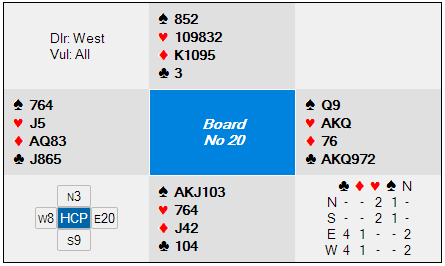
In the first half the Boards were pretty flat. Maybe we didn't shuffle enough. But the quality of the bridge was good and the match was tight. After 12 boards the score was just 15-20, meaning we trailed by 5 IMPs. In the hand before the mid-session interval I was dummy and pre ordered two teas, like I was at the theatre. This was the deal, a small gain for Team Merriman. East-West are vulnerable, and West is the dealer.

DannyAnna
WNES
-1♠2♣-
2♥--3♦
---

I was sitting North and opened 1♠. East overcalled 2♣. Since they were vulnerable, I guess he didn't fancy 3♣. West could have passed this (in which case I would have reopened with a double), but instead he bid 2♥. I passed and it was up to Anna as South. She decided to come back in with 3♦. I probably wouldn't have bid this, scared the whole hand was a misfit and defending was best. But Anna went for it, and it is a nice bold bid.

Against 3♦ West lead a club. Anna ducked this, won the next Club then played one more Club, West throwing a Spade and allowing her to ruff in dummy. She then played the ♠A and ♠Q, covered by the ♠K and ruffed in hand. When she played trumps West won and returned a Heart. Anna won and lead her winning Spade from the dummy, throwing a losing Heart and letting West ruff. So in the end the defence came to three Diamonds and a Club, for 3♦= and +110.

The hand diagram above is generated by a program called Bridgify, which is free to download (see www.bridgify.net). The numbers under the West cards show how many tricks the defence gets, depending on his lead. You can see that on the actual Club lead, the defence get only 3 tricks, meaning declarer could have made 3♦+1. This is from playing the Spades early on to establish a long Spade, but 3♦= was still a good result and we gained 4 IMPs on the hand.

I enjoyed my half time tea tremendously. For the second half we swapped opponents, and sat down with [?name] and his Mum. As they bid a series of games against us, I had a few tricky decisions. Once partner opened Spades, the next hand doubled, and I had a weak hand with five Spades. I think now it's all about tactics, and choosing the most cunning bid. My current maxim is always to pre-empt to the max so I went for a not very cunning immediate 4♠, prompting the next hand to bid and make 5♥. I wonder if I could have kept them out their game by shrewdly only bidding 2♠, or even passing.

There was one big swing hand, when our opponents accidentally got to 6NT after failing to stop in 4NT or 5NT. They played it very nicely and made it. This all confused me and when we bid to 6♣ on the next hand I was seriously on the tilt, playing a very straight-forward contract needlessly slowly. My chat plummeted at this point, and I commented that I was wearing a jumper and Anna wasn't.

After a tight first half we also narrowly lost the second half, 15-30. That lead to a final loss of 30-50, probably the right result against opponents' who made very few mistakes. Congratulations to them, and I hope they now go on to win the cup!

Tuesday, 29 April 2014

Misbidding big hands

Me and Anna went for Sushi last night then the Buchanan pairs. I had a duck mix served in a lettuce leaf instead of a plate, and we scored 60%. This was good enough for 7th out of 50 pairs (top score 67.95% by John Donaldson and Sandy Wilson). Here's two slam hands we bodged:

DannyAnna
WNES
3♣
4♥---
-

South opened with a fairly textbook Weak Three in Clubs. I was sitting West with 20 points, a Club stop, and solid Hearts. What should I bid? I could have bid a risky 3NT going for a matchpoint top, or doubled then bid Hearts. Jake taught me well last week at the New Melville Congress (see report here) that with a single suited hand it's best not to double, as partner might pass your double.

My hand isn't quite single suited here, but I think double is still dangerous. Whatever partner bids you're then in trouble for your next bid, and it might be hard to get your strength across. That's why I went for an immediate 4♥ bid, which I think describes my hand perfectly - a very strong hand with good Hearts, and certainly not a preempt after the opponents have preempted.

[Edit - from a discussion with Martin Stephens and the 'panel', which I would guess includes Phil Stephens, I've been informed that actually 4♥ here shows a slightly weaker and more distributional hand. With my actual hand I should in fact double, and trust that partner will take realise when I bid again I've got a monster. For example, after my double Anna could jump to 4♠, then I bid 5♥ to show a big hand with Hearts and Anna raises to 6♥]

Anna wasn't sure about the 4♥ bid, so took the cautious route and passed. She has a great hand to play in Hearts, and so I made an easy 12 tricks. One interesting point in the play - after drawing trumps I lead the ♠J, which North ducked, presumably in case partner had a singleton ♠K. I then fancied I had a chance of making all 13 tricks, as I discarded my ♠K from hand on the extra Diamond in dummy, then ruffed a Spade. If North had started with just ♠Ax the Ace would have come down and all of dummy's Spades would be winners.

Surprisingly, 4♥+2 scored an undeserved 52%, as a few tables only made 11 tricks, and the slam was bid only twice. This was a very conservative field. That's why we scored so poorly for overbidding this one:

DannyAnna
WNES
2♥x-
3♦-5♦-
6♦---

This time it's Anna who has a big hand and gets preempted. When North opens 2♥ she opted to double; I would have gone for an immediate 3NT. In response to her double I bid 3♦, although I'm maybe nearly good enough for 4♦. Anna then leapt to 5♦, which is pretty ambitious as I could be sitting opposite her with a 0 count and 4 small Diamonds. Since I had so much more than that, and expected at least 4 card support, I topped up to 6♦.

North lead the ♣J. You can see the contract ought go down, with a Club and Spade loser, but the interesting thing is how to play it to maximize your chances to sneak home. I think that's something expert players do very well, play to get a mistake from the opponents rather than giving up when they know they can't make it. I reasoned that there was no way North could have the ♣K for the ♣J lead, so the finesse was bound to fail. I went up with the ♣A, fearing South would win the King and give a ruff. This is foolish, as since no one else is bidding slam I'm going to get exactly the same score for 6♦-1 and 6♦-2 and I shouldn't worry about the ruff. In fact if I finesse the ♣Q, and South wins she's then got a tough problem. If she returns a Club, quite reasonably expecting partner to have a singleton Club, I can then set up my Clubs, discard Spades, and make the contract. An opportunity missed.

On 25 tables, no one else bid 6♦. So our 6♦-1 was worth just 8% of the matchpoints, as we beat the pair in 6♣-1 and drew with those in 5♣-1.

As Anna said afterwards "5♦ was a good contract, why didn't you just leave it in that?"

Sunday, 27 April 2014

New Melville Bridge Congress 2014 - Part Two (Teams)

This is Part Two of my report of the New Melville Bridge Congress. Part One was the pairs, see here.

After the pairs finished we dashed to the pub for lunch, and some analysis of the afternoon's play. Two veggie burgers and two hot dogs. As the official results weren't in yet the main aim was to determine which pair had done better. With an ad-hoc BAM scoring system me and John concluded we'd won, but since neither pair did well at all we decided to switch the partnerships for the teams. I would re-unite with Jake, and Martin would play with John.

Me and Jake have played together competitively about once a year, beginning with a valiant but doomed attempt to win the Portland Bowl cup for Edinburgh University (see here). We have settled into a system of Weak NT (11-14), five card majors, and Rubensohl even though I'm not too sure how to play it.

The Teams Tournament consisted of only four matches, each of six boards. To give myself an extra boost of freshness I changed my T-shirt before the first round.

Match One: 20-0 (Total 20/20 VPs)

In our first match me and Jake were against Derek Sanders and Cath Dempsie, while Martin and Jake played Deirdre Sanders and Michael Marshall.

There were two big hands. Firstly, I doubled the opponents in 5♦, holding ♠ AK952 ♥ T94 ♦ - ♣ AQT63 . It was slightly risky, and I got very worried when Derek said he was thinking about redoubling. But I made my three top tricks, and opposite my Diamond void partner had five of them, so also got two trump tricks and it went three off. On another board Martin and John also collected an 800 penalty. These two hands were enough for us to win the match by 28 IMPs, which translated into 20-0 VPs. A flying start!

I should also apologise to everyone for Board 4, which I played painfully slowly, eking out a tortuous 3NT+1.

Match Two: 20-0 (Total 40/40 VPs)

Remarkably we kept things going in the second round, playing against Liz Barr and Ritchie Thompson's team. Jake bid an aggressive 4♠ which they missed at another table, and I eked out another 3NT by ducking a lot. Those were both game swings in. On the other table Jake and Martin collected yet another +800 when Martin punished a poor 4♠. Collectively those three good scores lead to +27 IMPs and another 20-0 win. That meant that whatever happened we were bound to finish on at least half marks.

Match Three: 20-0 (Total 60/60 VPs)

On this round against John Hamilton's team we got a bit of luck resulting in two game swings. John and Martin missed this slam, but so did the opposition. I think it's very hard to bid:

You can see that East-West have a big Diamond fit. There's just one loser in Hearts, as all the losing Spades go on the top Clubs. Even if you miss the slam 5♦ is a much better contract than 3NT, which needs Hearts 4-4.

Here's three attempts to bid the hand. I've starred the conventional bids.

WE
1♦
2♦*2♥*
3NT
WE
1♦
2♦*3♦*
3♥3♠
3NT
WE
1♦
1♥2♣
5♦

The first one is from the opponents at my table. After the 1♦ opening there's an inverted minors response of 2♦, then East bids 2♥ to show a minimum (says nothing about Hearts) and West jumps to 3NT. Against 3NT I duly lead the ♥K and we got our four tricks. The second table is Martin and John bidding. This time after the inverted minor they used 3♦ to show a minimum, then West bid a natural 3♥. East didn't have enough in Spades to bid 3NT so bid 3♠, then West bid 3NT. What's the point of inverted minors if all it does is get you to 3NT?

The best auction I think was the third table from Derek Sanders and Cath Dempsie. East opens 1♦, West replies a natural 1♥ and East rebids 2♣. West has a powerful hand and jumps to 5♦. If instead of 5♦ West instead goes for a forcing 4♦, or fourth suit forcing you've a decent chance of finding the slam. On 24 tables 6♦ was bid only once, by Liz McGowan and David Liggatt I think.

Scoring up at the end of this match was more good news, we had enough IMPs for another 20-0 win.

Match Four: 12-8 (Total 72/80 VPs)

Going into the final round we were on 60 VPS out of 60, and our closest opponent on 45 VPs. This was the team of Irene Sime and David Kaye, who we had to play next. We all worked out that even if we lost the match by 17-3 (but no more), we would still win overall. I was terrified we were going to lose 20-0. I was pretty tired by now and went on a raid to the kitchen to get some tea. All I found was an old silver tin, which it turned out contained Earl Grey's, one each for me and Jake.

I was hoping for six flat boards. The first one ought to have been flat but I was too shy to rebid my Hearts, and so I landed Jake in a horrible 3♦-1 while the other table was easily making 4♥. Apart from some rather silly bidding with John in the morning, this was my only big blunder of the day. It cost us 10 IMPs.

This next board produced a heated debate in the Whigwam pub afterwards.
What do you open with the East hand? On our table the opponents opened 2♣, then rebid Clubs and got to a reasonable 5♣ contract. This went one off when the defence got two Spades and a Diamond - bad luck. When John and Martin sat East-West John opened the East cards 2NT [Edit - I had this backwards before, but I'm informed it was definitely John who opened 2NT]. Martin raised to 3NT and South lead a top Spade, the ♠A. The only signal the defence had available was for attitude, so when North discouraged South switched to another suit. What a relief for declarer! John took his ten tricks and we gained back 13 IMPs. On a different table when Derek was sitting East he instead opened 1♣, overcalled by South. He then twice cuebid Spades to try and encourage partner to bid 3NT. On the second time of asking Cath sitting West decided her ♠764 was a good enough stop and bid 3NT. North, not unreasonably, thought the opponents had Spades stopped so lead a Diamond. 3NT+1!

I have to admit if I was East I would have opened the hand 2NT. Of course it's not ideal, but so often you can make 3NT even when it's a bad contract (as happened here on two tables). However, Jake is adamant that 1♣ is the best bid. I now agree, as long as you are playing with a partner and opponents who will make sure the bidding doesn't die in 1♣.

These were not the flat boards were were hoping for. On the next one Martin had a big hand and launched himself all the way to 5♠. This went off one, for a game swing out. But then he got another good hand and this time propelled himself to an excellent 6♥, making +1 and not bid at the other table. Must have been stressful for John, with weak hands each time watching partner make forcing bid after forcing bid.

After those ups and downs the last two boards were mercifully dull, and in the end we won the match by 3 IMPs to give a 12-8 win in VPs. This gave us a stonking 72 VPs overall, and clear first place. I think we were pretty lucky, and just happened to have four good matches. Since the tournament only had four rounds there wasn't much scope for the best teams coming through, and expect with more rounds we might have slipped back a bit. It's odd we all did well in the teams having done poorly in the pairs; and similarly I noted that the two that won the pairs came last in the teams.

In conclusion: a famous win.

New Melville Bridge Congress 2014 - Part One (Pairs)

What a day! The New Melville Bridge Club is in Edinburgh, right next to the zoo. Me and John Faben got the early bus across from Glasgow and met the rhinos, gibbons, tapirs, and of course the pandas:


Yang Guang and Tian Tian

This was a very relaxing way to spend the morning and I will try and do the same before each bridge tournament.

At the club we were the last pair to arrive. We curtly acknowledged Martin Stephens and Jake Corry, who would be our team mates later in the day but for now were just another opposing pair. Altogether there were 55 pairs in the tournament. Two years ago I think John won the event playing with Phil Stevens. Last year, with a generous handicap boosting our score, me and Anna came 3rd and Jake and Martin second. Read my report of last year's congress here.

This year instead of Anna I was playing with John. We were playing a terrible system we'd devised called Puppet Culbertson. It consisted of normal Acol, with the addition of two conventions, Firstly, we would use Puppet Stayman wherever possible, even though neither of us really understood it (or maybe he did, but I didn't). Secondly, and more fundamentally, all slam auctions would be conducted using the Culbertson New Asking Bid. This means that once trumps are agreed any new suit bid asks partner if they have control in that suit. I'd just written an article about this convention in the Scottish Bridge News, and was delighted that John had agreed to play it with me.

Armed with our makeshift system, could me and John evoke the spirit of Culbertson and cut through the field and surge to triumph? No. Could we finish above 50%? No. Could we even beat Martin and Jake? Sadly not.

We had one early triumph, where I deliberately bid wildly and it paid off.

JohnDanny
WNES
-
-1♥4♦-
--

South and West passed and North opened 1♥. I had the East hand. Probably the right bid is 2♦, but with partner having already passed I decided to pre-empt. Also, I calculated that there was virtually no chance of making a Puppet Stayman or Asking Bid on this auction, so we might as well get the hand over quickly. I bid an immediate 4♦. This puts South under pressure. I would definitely have bid something, not sure what, but she passed.

South lead a Heart against 4♦. When I saw dummy I was pleased John had such a weak hand, so thought the opponents probably had a game somewhere which they've missed. Although they only have a seven card Heart fit they're almost certain to make 4♥, and also 5♣ is easy. Also, as the hand record above shows, if North is declarer he can make lots of tricks in No Trumps. I know on Jake's table North-South did bid 5♣ so East-West sacrificed in 5♦x-1. Luckily I was only in 4♦, and I've a good chance of actually making it. On my table the defence cashed their two top Hearts then North lead another Heart. I was able to ruff high and start on Clubs, in the end just losing two Hearts and a Club to make +130. This was a top score for East-West, but strangely only got us 98%. Looking at the results here, there are a few results where someone should have got 0% or 100% but instead got 2% or 98%. Don't suppose it matters much. Anyway, that was our best board. I followed this success by doubling 2NT on the next deal, which declarer made with a healthy three overtricks.

About half way through the event me and John were doing quite well. There was one Puppet Stayman 'success', where we accidentally missed our 4-4 Heart fit but ended up making 10 tricks in 3NT for a good score. But then came Culbertson Corner. For one round we were sat right in the corner of the room, and unfortunately for us, both boards gave me an opportunity to use our slam bidding convention, which I eagerly took. On the first one, John wasn't playing ball:

JohnDanny
WNES
-
1♦-4♥?-
--

John opened the West hand 1♦, and I got very excited sitting East. Straight away I'm thinking slam. I've got a Diamond fit and five losers. I know it's matchpoints, and we should look for a major fit, but if I bid 1♥ it might be hard to set Diamonds as trumps later. I decided to make an immediate Asking Bid in 4♥. The question mark in the auction above indicates that 4♥ is an Asking Bid, not that it's a dubious bid (it's textbook). The bid is supposed to set Diamonds as trumps and ask partner for second round control in Hearts. We'd discussed on the bus that Asking Bids are normally at the four level, so even though 3♥ would be basically the same, I decided to keep it simple and bid 4♥. John went into a think. Was he trying to recall the Culbertson Table of responses to Asking Bids? No, he was wondering if 4♥ was natural. In the end he passed. Disaster.

South lead the ♣A against 4♥. I decided that my goal for the hand was to not show any emotion and give away that we'd had a mix up. Secondary to that I would try and make the contract. I didn't think that mattered much as everyone else would be scoring better for being in a slam. But the ♣A revived my interest, and I now actually had a decent chance of making it. I crossed to the ♦A and finessed the ♥7. South won the ♥Q and returned a Spade. I went up with the ♠J, so now had only two top Spade winners. I cashed these, along with two Clubs, managed to sneak three Diamonds by the defence, and finally a Spade from table trapped North's ♥KT under my ♥AJ so I lost just two Hearts and a Diamond for 4♥=.

It was fun to make such a poor contract, and enjoyed playing it recklessly quickly - normal speed for everyone else I expect. But would we get any Matchpoints? Thank goodness for Jake and Martin. They bid to 6♠, and went off, as did a few other tables, so we got 34% for +420. John said afterwards that he was thinking about replying to my Asking Bid, but knew the proper response was 6♦, showing second round control in my asked suit (Hearts) and the outside Ace of Diamonds. He didn't want to leap to 6♦, but it would have been a great result. Got to trust the system John, don't argue with Culbertson.

Perhaps overly concerned by missing slam on that Board, on the next one I got rather carried away. In a competitive auction John invited me to game, and with a shapely 6 point hand I decided that actually game wasn't enough. I drove us to a terrible slam via not one but two Asking Bids. I'll not reprint it, as no one will benefit by seeing that auction again. When dummy came down I was delighted it actually had some play. How do you fancy 6♠ by East?

South lead the ♣A, and then switched to the ♦K. At the time I assumed that she had ♦KQ, but looking at it now that was a very bold switch to the ♦K. It didn't matter here. It was all about the Heart suit. I drew trumps, (carefully unblocking the ♠8 so I still had an entry to dummy) then played three rounds of Hearts. If they were 3-3 I was home. They weren't though.

There's a hand in The Bridge Memoirs of Robin Hood by David Bird where Robin and his partner make a slam, and the opponents exclaim in surprise. Just 21 points between you and no singleton or void, how did you do it? We had only 21 points there, and no singleton or void, that could have been our Robin Hood moment. Instead we were the only East-West pair to get a negative score on the board, and duly got 2%.

Overall we finished on 47.7%, just behind Martin and Jake. Not a victory for Puppet Culbertson, but also we didn't play or defend very well. Congratulations to the winner Dilys Gellatly and Marjorie Murray who scored an excellent 64.36%. Full results on the New Melville website.

Friday, 25 April 2014

I demand a recount - Deal of the Week #19

Here's a fun deal from this Thursday lunch time, which features far too much bidding and not enough passing.


Dealer South
EW vul
♠ Q J T 9 7
♥ A J x
♦ x
♣ J x x x
♠ -
♥ x x x
♦ A K x x x x x
♣ x x x
9
79
15
♠ K 8 6 3
♥ T x x x
♦ x x
♣ A Q x
♠ A 5 4 2
♥ K Q x
♦ Q J x
♣ K T x
APJWDannyNC
WNES
1♠
3♦3♠4♦4♠
5♦5♠x-
--

NC dealt and opened the South hand 1♠, eschewing the more obvious Strong 1NT. AP sitting West jumped in with 3♦, nicely describing his hand. JW sitting North likes the Spades but holds back and bids only 3♠. I was sitting East. I thought there was a decent chance that my partner meant 3♦ as a strong hand, so I felt I ought to support him. No bid seemed right (a good indicator you should pass), but nonetheless I pulled out a bid of 4♦. South has a flat average hand with lots of defence so should pass this, but instead bid 4♠. West should then also pass, having shown his hand the first time with 3♦, but instead bid again with 5♦. North now had a think, and rather than passing (then partner doubles), he bid a reckless 5♠. That's four bids in a row, one from each player, where I think they should have passed but instead they bid. Finally, I ended the auction with a double, delighted to have avoided playing 5♦x (four off, -1100).

NC was declarer in the high pressure contract of 5♠x. West began naturally enough with a top Diamond, then switched to a Club, and I took my ♣A and returned a Diamond, ruffed in dummy. Declarer now needs the rest. You can see that with the Club and Spade finesses working he should be OK, as long as he can arrange entries to dummies to finesse in both suits. NC was already in dummy with the Diamond ruff and duly finessed in Spades, three times, finally snaring my useless ♠K. He could now cross to the ♥A and finesse in Clubs, risking going two off it loses. Instead he cashed all his Heart winners and the ♣K, finishing in hand. He got down to just one card left, and I was sitting East deciding which I should keep - the top remaining Heart or the top remaining Club? I had a think and shrewdly worked that declarer must have a Heart left, so chucked away my master Club. Except, of course, I was wrong, declarer had one more Club and duly scored the ♣T to make 5♠x. Big points to NC and JW.

Not sure how I miscounted. I was sure partner only had two Hearts, leaving declarer with four. One of them went missing somewhere!

With that big score NC and JW took an unassailable lead in the week.

Clearly we were shuffling well because this was the next hand:


S deal
♠ K Q x x x x
♥ K
♦ -
♣ K Q x x x x
♠ A
♥ x x x x x x
♦ K x x
♣ A J T

How do you get to 6♣?